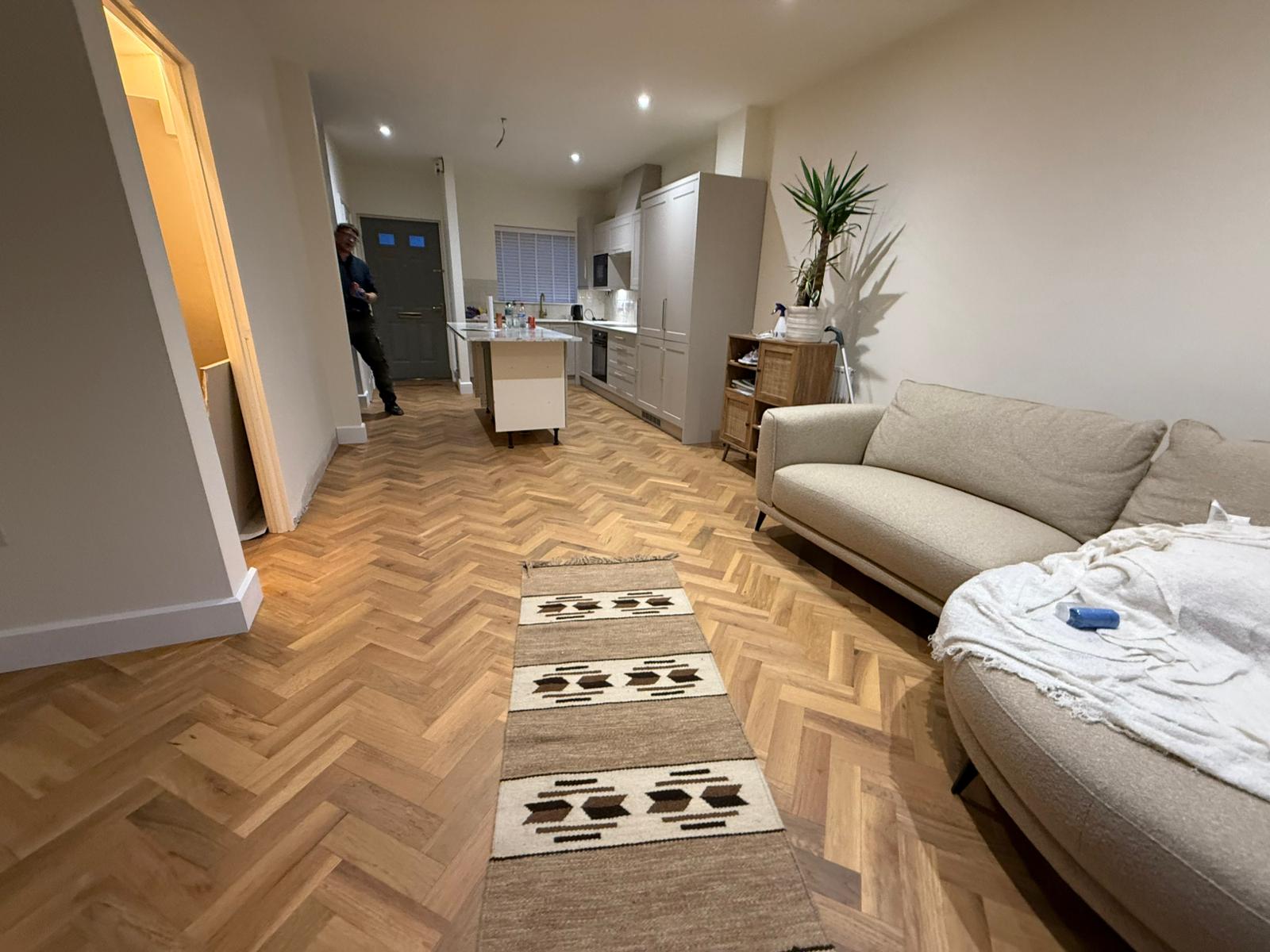
Laminate, LVT and engineered wood herringbone — properly laid, properly prepared, properly finished.
Herringbone is one of the most popular flooring choices for Cardiff homeowners right now — in hallways, open-plan living areas, and kitchen-diners. It creates a depth and quality that straight-lay flooring cannot match. But it has to be laid correctly, or it shows.
The pattern is made up of rectangular boards — laminate planks, LVT tiles, or engineered wood strips — laid in a V-shape zigzag. Unlike straight lay, herringbone requires careful centre-line planning before a single board goes down. The entire pattern works outward from that starting point, which is why a rushed or poorly planned job quickly looks wrong — misaligned rows, uneven margins at the walls, or awkward cuts around doors and kitchen units.
We have fitted herringbone flooring in Cardiff homes and know exactly where the problems come from. We take the time to plan the layout properly, prepare the subfloor correctly, and finish the edges cleanly.
Herringbone takes longer to install than straight lay — more planning, more cuts, more material wastage. This is why it costs more. We always quote herringbone separately from straight-lay pricing and explain exactly what is included.
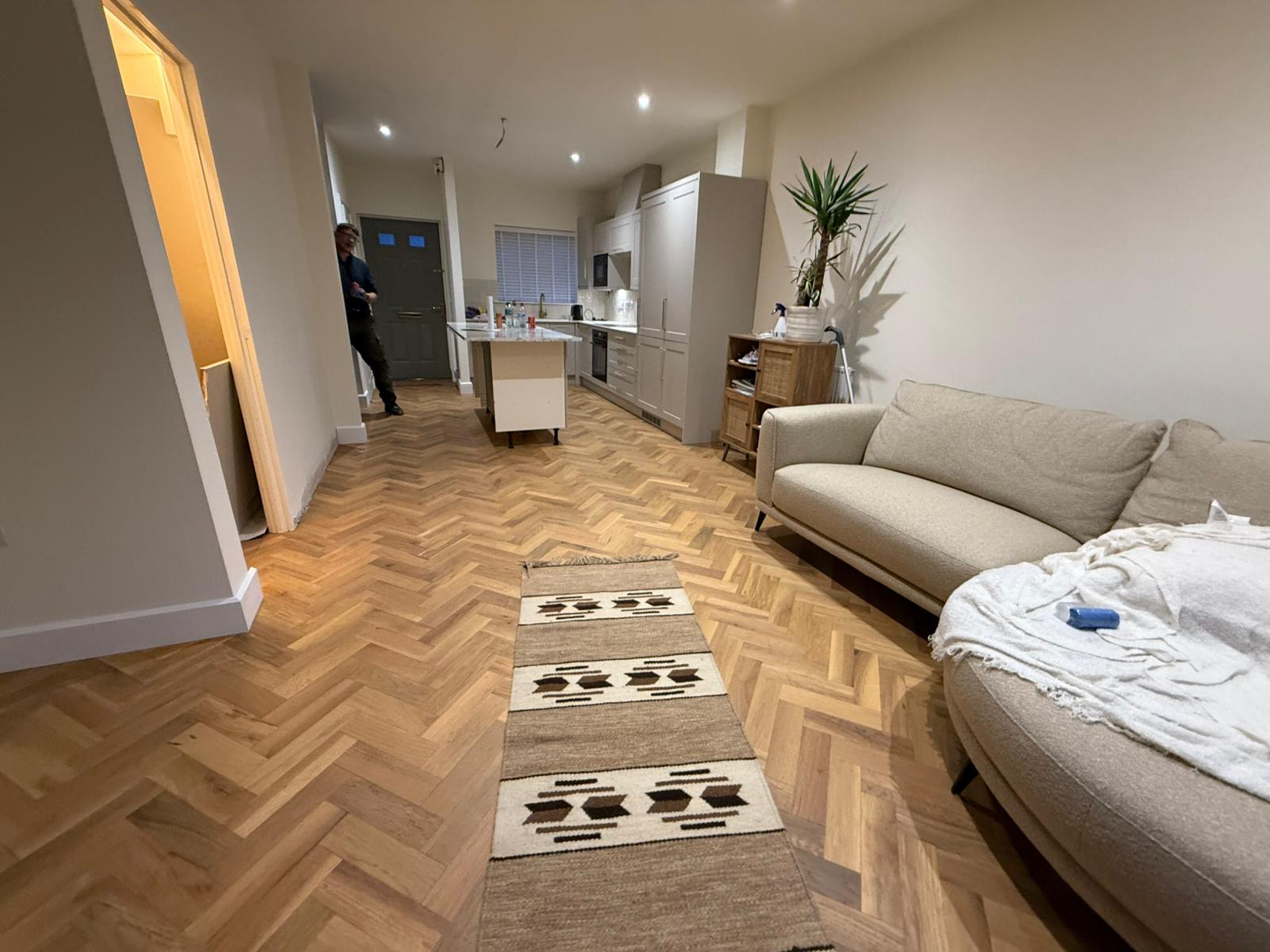
Herringbone is not just straight-lay flooring at a different angle. The way the pattern works creates specific challenges that take more time and more skill to manage properly.
Herringbone — particularly glue-down LVT — requires a very flat subfloor. Any unevenness shows through the pattern more obviously than with straight-lay boards. We check and address this before anything else.
The centre line and starting point determine how the entire pattern sits in the room. Get this wrong and you end up with awkward slivers at the walls or the pattern running off-angle. We plan this first, every time.
Every edge of the room requires more cuts than straight-lay installation. The herringbone pattern also typically generates more off-cut waste, which needs to be factored into the material estimate from the start.
Cutting herringbone around door frames, kitchen unit plinths, and step thresholds is more involved than with straight lay. The pattern has to terminate cleanly — rushed cuts show immediately.
A herringbone floor takes longer to install per m² than a straight-lay equivalent. Trying to rush it is how mistakes happen. We factor in the time needed to do it properly.
These are guide figures only. Every job is different depending on the subfloor condition, room size and shape, product type, and what finishing is required. We always confirm the full scope and cost before starting.
| Service | Guide Price | Notes |
|---|---|---|
| Herringbone laminate — labour only | From £18–£24/m² | Good subfloor condition, standard room |
| Herringbone LVT (click) — labour only | From £20–£26/m² | Requires flatter subfloor than laminate |
| Herringbone engineered wood — labour only | From £22–£30/m² | Depending on product and fixing method |
| Subfloor levelling | POA | Quoted separately after subfloor inspection |
| Old floor removal and disposal | From £80–£160 | Depending on floor type and area |
| Scotia / threshold trims | Quoted per job | Material and fitting included in quote |
| Material sourcing (supply & fit) | Trade price + fit | We source at trade cost and advise on suitability |
Why is herringbone more expensive to fit than straight-lay?
The pattern requires more planning, more cuts, and more time per m² than standard straight-lay installation. The boards are rectangular and laid in a V-shape zigzag — but getting that pattern to sit correctly in a room, terminate cleanly at the walls, and work around obstacles takes significantly more skill and time than a straight run. The material wastage is also higher, which needs to be allowed for in the product order.
Can herringbone be fitted over existing tiles or a concrete floor?
Sometimes, but the subfloor has to be flat enough. Most manufacturers specify a maximum deviation of 3mm over 1.8m for laminate — tighter tolerances apply for glue-down LVT. We check the subfloor as the first step on every job and advise on what levelling, if any, is required before installation can begin. We will not lay herringbone over a subfloor we are not satisfied with.
What underlay do you recommend for herringbone laminate?
For herringbone laminate on concrete, we recommend a high-density underlay with an integrated moisture barrier. Thin foam underlay does not provide adequate support for the pattern and can cause movement over time. We advise on underlay as part of every flooring quote — the right underlay makes a real difference to how the floor feels and how long it lasts.
Do I need to remove the skirting boards?
Not always. If the skirting is staying in place, we fit scotia beading to cover the expansion gap neatly. If you prefer the skirting to be removed and refitted — or replaced — we can do that as part of the job. We discuss this at quote stage so you know exactly what the finish will look like and what it will cost.
How long does a herringbone floor take to fit?
A typical living room or hallway of 20–30m² takes one to two days, depending on the subfloor condition and complexity of the room. If levelling compound is needed, it must cure fully before installation begins — this adds time to the overall job. We always give a realistic timeline before starting, not an optimistic one.
Can you supply the herringbone flooring as well as fit it?
Yes. We can source herringbone laminate, LVT, and engineered wood at trade cost and manage everything from product selection through to installation. If you have already purchased your flooring, we can work with that — but we will always check the product is suitable for the subfloor and the conditions before we start.
Do you cover the whole of Cardiff?
Yes — we work across Cardiff and the wider South Wales area including the Vale of Glamorgan, Newport, Caerphilly, and Bridgend. See the full area list below.
House2Home Renovation Projects is a Cardiff-based flooring and renovation company specialising in herringbone laminate, LVT, and engineered wood installation across Cardiff and South Wales. We have been completing domestic flooring projects since 2016 with over 200 projects completed.
Herringbone has become the most requested flooring pattern for Cardiff homeowners — particularly in hallways, open-plan ground floors, and kitchen-diners. The pattern creates a visual richness that straight-lay flooring simply does not have. Done properly, it transforms the feel of a space. Done poorly, it looks worse than a flat run of boards would have.
The most common herringbone failure we see in Cardiff properties is inadequate subfloor preparation — particularly on older houses with uneven concrete floors or previous layers of flooring that were not fully removed. The second most common issue is poor planning of the starting point and centre line, which causes the pattern to look off-balance in the room. We address both of these as standard practice on every job, not as optional extras.
Whether you want herringbone laminate in a hallway, herringbone LVT in a kitchen, or engineered wood herringbone in a lounge, we will advise on the right product for your subfloor, quote clearly on what the job involves, and deliver a finish that reflects the standard you paid for.
Areas We Cover